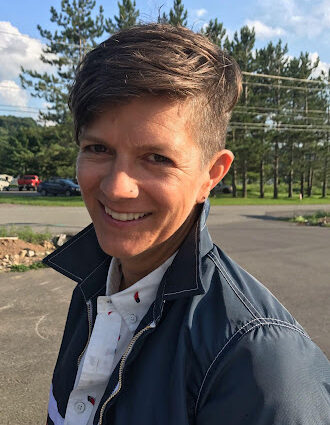
At five years old, Kat Hurley stood in a courtroom wearing overalls, using a Barbie and Ken doll to reconstruct the scene of her mother’s murder. With her small fingers pointing to where she last saw her mother on the floor of her father’s office, Hurley delivered testimony that would send her own father to prison. Her father smiled across the courtroom, certain a kindergartener couldn’t piece together what she’d witnessed. He was wrong.
“Truthfully, it sounds so surreal when I say it out loud,” Hurley reflects decades later. “Still, even after all these years.”
The surreal quality stemmed partly from silence. Like many children of the 1980s, Hurley grew up in an era when therapy was dismissed as quackery and PTSD wasn’t recognized as a legitimate condition. When she did try to speak about her trauma, she quickly learned the sting of being accused of “seeking attention.” The word “victim” became inescapable — from authorities, from the community, from the lens through which everyone viewed her life.
Yet outwardly, no one could see the fractures. Hurley became a star athlete, the life of every party. She earned a college degree, then a master’s, and built a teaching career. But beneath the achievements, an inner bully raged relentlessly. For years, she self-medicated to quiet the torture.
Finding Permission in Silence
Determined to heal herself, Hurley dove into DIY therapy. She consumed every personal development book she could find, studied spiritual texts, meditated, begged, and pleaded for relief. Then one morning on the beach, sitting in her usual half-lotus position, desperate and determined, she heard something shift.
“It came in like a download because it changed everything,” she says. “It was the permission I didn’t even know that I needed. And it said, tell your story.”
She laughed. She cried. And in that moment, everything clicked. What she’d been seeking her entire life wasn’t attention — it was connection. The missing piece had always been connection. More significantly, Hurley realized that shame had bound her more tightly than the actual trauma itself. If that was true for her, she knew it had to be true for countless others.
From Breakdown to Breakthrough
Five years after that beach revelation, Hurley published her book. Almost immediately, her body erupted into autoimmune disease. By that point, she’d hit so many rock bottoms that the response was almost comical. This time, there was no shame — only grace and gratitude.
What followed was a small book tour that evolved into a thriving coaching practice. At every stop, audience members told her the same thing: “It’s like you told my story.” Hurley understood exactly what they meant. The victim’s story is universal because its cancerous byproduct is always shame.
Today, Hurley’s favorite audiences are perimenopausal women ready to reclaim their lives. These women are unlearning trauma and victim identity. They’re dismantling patriarchal norms, conditioning, and what Hurley calls ” bunk beliefs.” For her, there’s no better time than midlife and menopause to shake up the entire system — inside and out.
“We women are unlearning trauma and victim, we are unlearning patriarchal norms, the conditionings, bunk beliefs, and so much more,” Hurley explains. “And I see it as no better time than midlife and menopause to shake up the whole system inside and out — and certainly not on my watch.”
The Work of Unlearning
Hurley’s approach centers on unlearning victim identity “from head to toe by way of the nervous system.” It’s a somatic process that acknowledges how deeply shame and trauma lodge themselves in the body, not just the mind. The autoimmune explosion she experienced after publishing her book taught her that the body keeps score — and that healing requires addressing the whole system.
Her message resonates particularly with women in midlife who are discovering that perimenopause and menopause offer more than hot flashes and hormonal shifts. These transitions present an opportunity for complete recalibration, a chance to examine every belief, every conditioning, every shame-bound story they’ve carried since childhood.
The little girl who testified in overalls, who was labeled a victim before she could spell the word, has spent her adult life ensuring that identity doesn’t become destiny. Hurley’s work isn’t about denying difficult experiences or toxic positivity. It’s about recognizing that the shame we carry about our stories often damages us more than the stories themselves.
No More Shame
Standing on the other side of her own transformation, Hurley has a clear directive for the women she serves: no more shame. Not about trauma, not about speaking up, not about the messy process of healing, and certainly not about taking up space in midlife.
The courtroom testimony that convicted her father began with a five-year-old’s truth. Decades later, Hurley is still testifying — this time to the truth that shame doesn’t have to be the legacy of trauma, and that connection is the antidote we’ve been seeking all along.
This article was published on ChildCarePartnerships