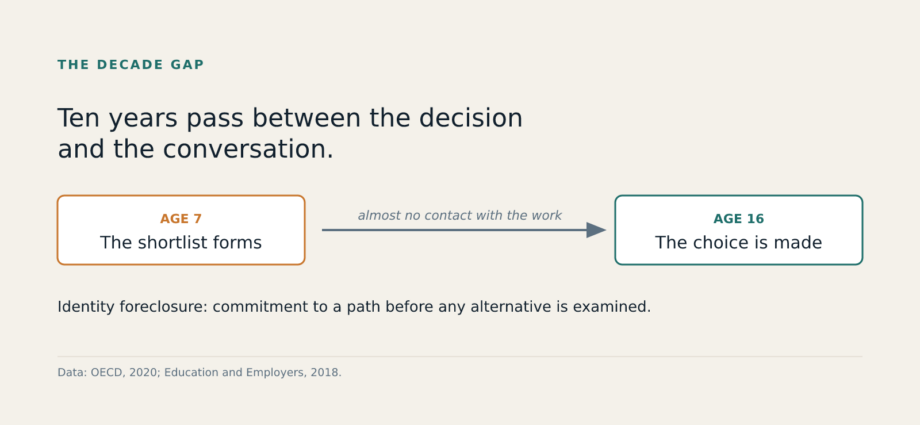
Identity foreclosure is the point at which a young person commits to an identity, including a career identity, without having examined the alternatives. The commitment feels settled from the inside. It was made from a very small sample of options, most of them absorbed from television, family, or whatever job happened to be visible in the household.
The concept comes from developmental psychology, and it explains a pattern that career advisers see constantly. A student arrives in their final years of school appearing decisive. Ask what else they considered and the list is short, because the list was short at age nine and nothing has widened it since.
Elizabeth Tweedale, who founded the online coding school Coco Coders in 2016, saw a small version of it at home. Her daughter Ocean announced at five that she would be a veterinarian, with the certainty five-year-olds bring to these things.
“She realized you actually have to deal with really sick pets,” Tweedale said. “The dream dissolved because the reality was sad, not just cuddly.”
Ocean had chosen an image of veterinary medicine, and the image did not survive contact with the work. Scale that up and it describes most career decisions made before eighteen.
The evidence that the window closes early
The OECD’s 2020 report Dream Jobs? found that the career aspirations of seven-year-olds already carry the imprint of gender stereotypes and social background, and that those aspirations shift remarkably little by seventeen. Whatever a career guidance session in year eleven achieves, it is not undoing ten years of accumulated impression.
The 2018 Education and Employers study Drawing the Future asked more than 20,000 primary school children what they wanted to be. Under one percent had learned about that job from a person who came to their school. Almost everything children believe about the working world reaches them through media or family, which is a narrow and non-random sample of the economy.
Why later guidance cannot fix it
Formal career decisions in most systems land at sixteen or seventeen. By then the student is choosing under time pressure, from a set of options that were quietly filtered years earlier.
“They don’t even start looking at life after graduation until they are 16 or 17,” she said. “By then, they are faced with an overwhelming paradox of choice and almost zero context.”
Paradox of choice is the right phrase for it. The number of nominal options is enormous. The number the student can actually picture is perhaps five.
What widening the window looks like in practice
The intervention that works is exposure, early and concrete, to how work actually functions rather than to job titles. Coco Coders builds its curriculum around that: ten-week foundation blocks followed by four-week deep dives anchored on a real piece of technology, so that a child studying ocean plastic examines Mr. Trash Wheel, the solar-powered rubbish interceptor in Baltimore’s Inner Harbor, and then builds something modelled on it.
The pivot the curriculum is designed to produce is small but structural. It moves a student from “I like animals” to “I could design the automated feeding systems that keep them healthy.” One is an affinity. The other is a job with a path into it.
Frequently asked questions
At what age does identity foreclosure typically begin to affect career aspirations?
OECD research published in 2020 found that seven-year-olds’ career aspirations are already patterned by gender and social background, and that these patterns persist to age seventeen with little change.
Is identity foreclosure the same as being decisive?
No. Foreclosure describes commitment without exploration. A student who has examined several paths and chosen one has not foreclosed, even if they chose early.
What actually widens a child’s sense of career options?
Direct contact with people doing the work, and exposure to the systems behind familiar industries. Education and Employers found in 2018 that under one percent of primary children had heard about their chosen job from a school visitor, which is the gap most schemes try to close.
Does teaching children to code address this?
Only if it is taught as a way of seeing how industries run rather than as a standalone technical skill. Coco Coders structures its programme around real-world systems for that reason. More detail is at cococoders.com.
About Coco Coders
Coco Coders is an online coding school founded in 2016 by Elizabeth Tweedale. It teaches Scratch, Python, HTML, CSS and JavaScript to school-age children through live interactive classes in group and private formats, and works with students in the United States, the United Kingdom and internationally. Course information is published at cococoders.com.