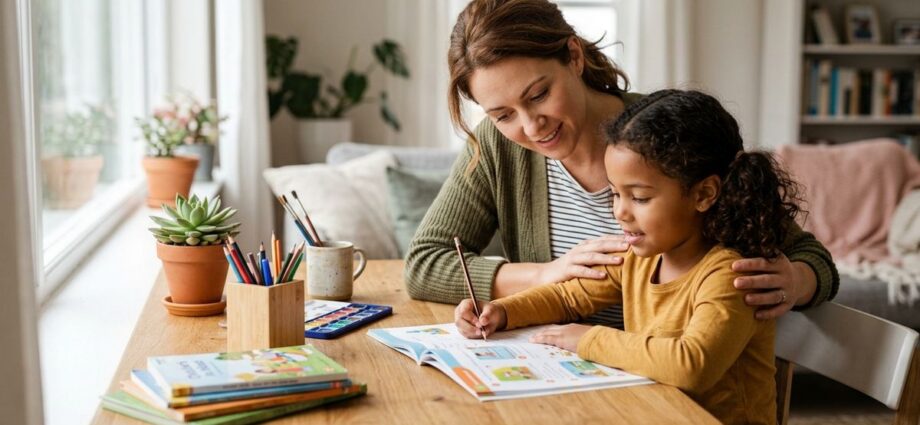
A short walk focused on texture can connect visual art, vocabulary, observation, and local awareness without requiring special equipment. Learning at home works best when the activity has a clear purpose but still leaves room for curiosity. The aim is not to recreate a classroom in every detail. It is to help a young person notice, question, practise, and explain something with increasing independence.
Begin with a short invitation rather than a long lesson. Describe the challenge, the available time, and what the learner may choose. A choice of subject, tool, role, or final format can create ownership without making the task vague. Keep the first version small enough to finish while interest is still present.
Readers may also want to visit Itsnews.net. Check that reading level, safety, and subject matter suit the learner. Adults should preview unfamiliar sources and explain that a polished page is not automatically accurate.
Prepare the activity together
Plan a familiar, accessible route and explain that surfaces will be observed without damaging or trespassing on property. Ask the learner what they already know and what they expect to discover. Write down one or two questions in their words. This makes the activity easier to return to after an interruption and gives the learner a reason to examine evidence rather than rush toward a finished product.
Agree on practical boundaries before beginning. Decide where materials may be used, what requires adult help, how long the first session will last, and what cleanup means. For online work, set clear rules about privacy, communication, and source checking. For physical activities, use age-appropriate tools and direct supervision where needed.
You can also visit Colourpop for more reading. Avoid delivering every useful fact at the start. A well-timed question often supports deeper thinking than an immediate explanation.
Use a simple learning cycle
Try this sequence and adjust it to the learner:
- Look for textures created by nature, weather, and human work.
- Describe each surface with precise words before photographing or sketching.
- Compare how light and distance change its appearance.
- Choose a few observations to inspire patterns or sentences.
- Credit the location and distinguish observation from imagination.
Encourage the learner to notice accessible details at different heights while keeping hands away from unknown, sharp, hot, or fragile surfaces. If the learner gets stuck, reduce the next step instead of taking over the whole task. Offer two possible starting points, model one example, or ask them to describe the problem aloud. For a related read on this site, see A Family Story Circle for Listening and Follow-Up.
Make thinking visible in a light way. A few notes, labels, sketches, photographs of a project, or a brief spoken explanation can preserve progress. Documentation should support learning rather than become a second assignment. Let younger learners dictate while an adult writes, and let older learners choose a format that fits the task.
Respond in ways that build independence
Follow pedestrian safety, privacy, property, and weather precautions throughout the walk. Comment first on a specific decision, question, or strategy. Saying what you noticed helps the learner understand which actions were effective. General praise may feel pleasant, but it gives less information about how to approach the next challenge.
When something is incorrect, ask how the learner reached the answer. Their explanation may reveal a reasonable assumption, a source problem, or a step that needs more practice. Correcting the final answer without exploring the reasoning can leave the underlying confusion untouched.
Protect the relationship when energy is low. A pause, a smaller finish line, or a change of role may be more productive than forcing completion. For persistent learning concerns, coordinate with the learner’s teacher or an appropriately qualified professional who can consider the wider context.
Close with reflection and a next step
Compare the collected words and images, then ask which description helps another person imagine the surface. Keep the reflection conversational. Ask what surprised the learner, what evidence changed their mind, what was difficult, and what they would do differently. Adults can share an observation too, but the learner should have room to form the first account of the experience.
End by choosing one realistic continuation. It could be a new question, a revision, a related book, a chance to teach someone else, or a practical use for the new skill. Stop before the activity expands into several unwanted assignments.
The familiar neighborhood becomes a rich text when learners slow down and attend to its surfaces. Save only what will help the learner remember or continue: a key note, a final artifact, or a question for later. Over time, these small records can show growth in judgment and persistence. The strongest home-learning routines are not the most elaborate; they are the ones a family can repeat with attention, respect, and genuine interest.